- Published on
Best Espresso Machines Under $1000 in 2026: Top 3 Comparison
- Authors
- Name
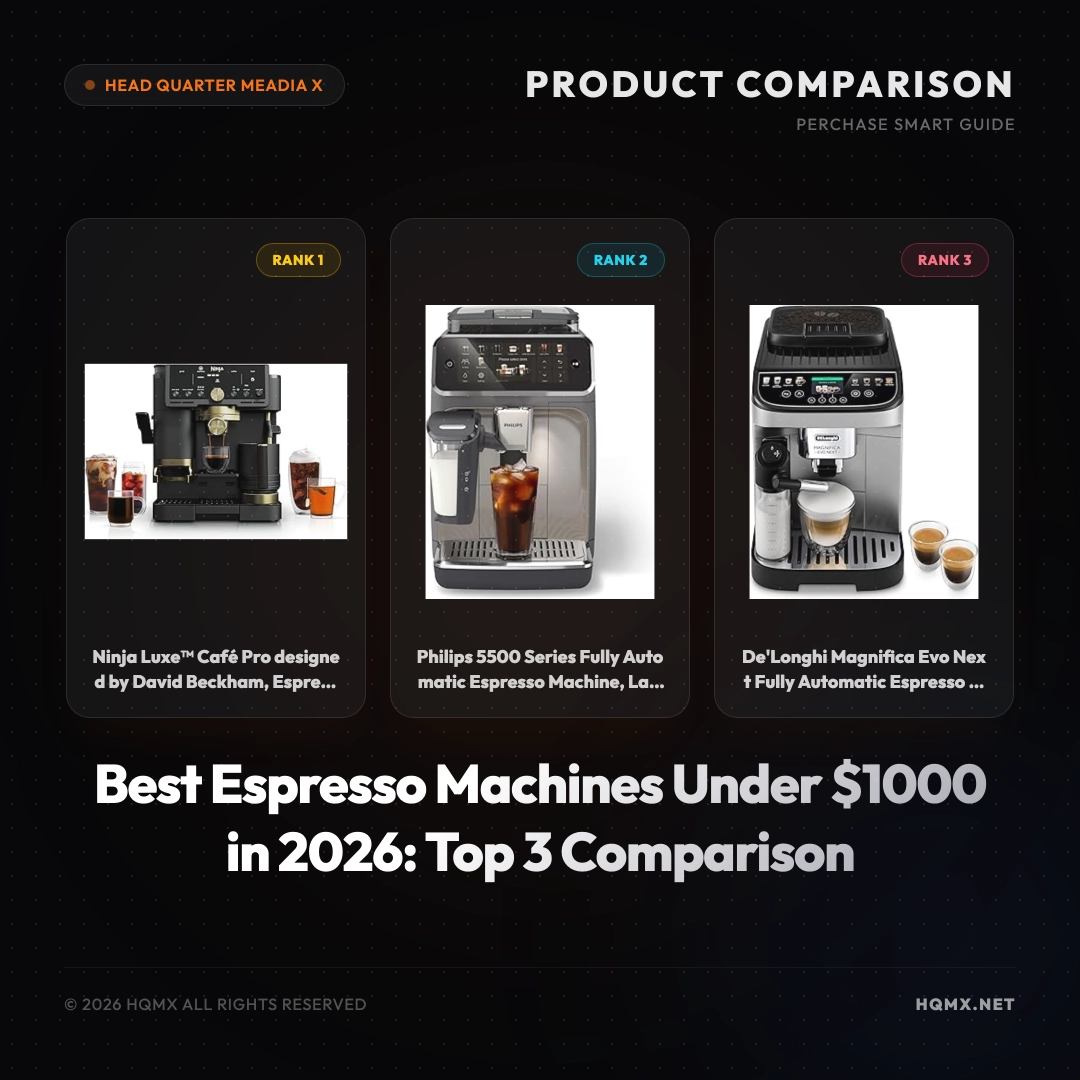
| Feature | Ninja Luxe Café Pro (Analysis 1) | Philips 5500 Series (Analysis 2) | De'Longhi Magnifica Evo Next (Analysis 3) |
|---------|-------------------------------|-------------------------------|----------------------------------------|
| MSRP | $899.99 | $764.15 | $910.71 |
| User Score | 4.5 | 4.5 | 4.5 |
| Integrated Grinder | Yes (built-in) | Yes (ceramic) | Yes (steel) |
| Milk System | Hands-free frother | LatteGo milk system | Milk frother (steam wand) |
| Brew Options | Espresso, drip, cold brew, hot water | 20 hot & iced coffee pre-sets | Espresso, latte, cappuccino, americano, tea |
| Pressure | 19 bar | 15 bar | 15 bar |
| Water Tank | 72 oz | 60 oz | 60 oz |
| Dimensions (inches) | 11.2 x 12.7 x 14.5 | 10.0 x 14.0 x 17.0 | 9.3 x 17.7 x 14.4 |
| Weight (lbs) | 20 | 19 | 20 |
Buyer's Guide: Choosing an Espresso Machine
Before comparing specific models, understand the core technical factors that determine espresso quality. These principles apply regardless of brand or MSRP point.
Pump Type & Pressure Stability The pump is the heart of every espresso machine. Vibration pumps (common under 1,000+) deliver smoother, more consistent pressure profiles. The industry standard for espresso extraction is 9 bar — machines advertising 15 or 20 bar often measure peak pump capacity, not brewing pressure. An over-pressure valve (OPV) regulates this to 9 bar at the group head.
Boiler Architecture & Temperature Stability Single boiler machines share one boiler for brewing and steaming, requiring temperature switching (surfing) between functions. Heat exchanger (HX) machines use a copper tube inside a steam boiler to flash-heat brew water, enabling simultaneous brew/steam but requiring cooling flushes. Dual boiler machines maintain independent, PID-controlled boilers for brewing and steaming — the gold standard for temperature stability and workflow.
Pre-infusion & Pressure Profiling Pre-infusion gently wets the coffee puck at low pressure (2-4 bar) before full pressure ramp-up. This reduces channeling and improves extraction uniformity. Advanced machines offer programmable pressure profiling — varying pressure during the shot (e.g., declining pressure profiles) to highlight specific flavor characteristics.
Build Materials & Serviceability Stainless steel boilers resist scale better than brass/aluminum. Commercial-grade components (E61 group head, saturated group) improve thermal stability. Consider parts availability and community support for long-term ownership.
Analysis 1: Ninja Luxe Café Pro (ES771BK)
Technical Key Specificationss
The Ninja Luxe Café Pro is a versatile countertop appliance that combines espresso, drip coffee, cold brew, and hot water functions in one unit. It features a built-in grinder with an integrated tamper for consistent espresso extraction. The machine utilizes a 19-bar pump pressure system and a Thermoblock boiler for rapid heating. The water tank capacity is 72 ounces, and the bean hopper holds 12 ounces. It includes a hands-free frother that automatically textures milk for lattes and cappuccinos. Dimensions are 11.2 x 12.7 x 14.5 inches, and it weighs 20 pounds. The machine also offers a pre-brewing function to enhance flavor.
Why This Analysis
The Ninja Luxe Café Pro is ideal for users who want a multi-functional machine capable of brewing espresso, drip coffee, and cold brew. Its integrated tamper ensures easy puck preparation, and the hands-free frother simplifies milk texturing. The large water tank reduces refill frequency, and the 19-bar pressure yields rich crema. It is ranked first for its versatility and ease of use, catering to households with diverse coffee preferences.
Strengths and Limitations
- Strengths: Versatile brewing options (espresso, drip, cold brew); integrated tamper for consistency; hands-free milk frother; large 72 oz water tank; 19-bar pump pressure; sleek design.
- Limitations: Bulky footprint; no separate hot water dispenser for tea; grinder may be noisy; higher MSRP point.
Analysis 2: Philips 5500 Series Fully Automatic Espresso Machine (EP5544/94)
Technical Key Specificationss
The Philips 5500 Series is a fully automatic espresso machine with a ceramic grinder that offers 12 adjustable grind settings. It features the LatteGo milk system, which prepares silky milk froth with minimal cleaning. The machine has 20 hot and iced coffee pre-sets, including espresso, latte, and cappuccino. It uses a 15-bar pressure pump and a Thermoblock boiler. The water tank capacity is 60 ounces, and the bean hopper holds 8.8 ounces. Dimensions are 10.0 x 14.0 x 17.0 inches, and it weighs 19 pounds. The SilentBrew technology reduces noise during operation.
Why This Analysis
The Philips 5500 Series is ranked second for its exceptional value and ease of maintenance. The LatteGo milk system is dishwasher-safe and requires no steam wand cleaning. With 20 pre-sets, it offers convenience for both hot and iced beverages. The ceramic grinder provides consistent grind size and is quieter than steel burrs. Its compact design fits well in most kitchens, and the lower MSRP makes it an attractive option for budget-conscious buyers.
Strengths and Limitations
- Strengths: 20 pre-sets for variety; LatteGo milk system (easy to clean); ceramic grinder (durable, quiet); SilentBrew technology; compact size; affordable MSRP.
- Limitations: Plastic construction feels less premium; no integrated tamper; water tank is smaller than Ninja; limited to 15-bar pressure.
Analysis 3: De'Longhi Magnifica Evo Next Fully Automatic Espresso Machine
Technical Key Specificationss
The De'Longhi Magnifica Evo Next is a fully automatic espresso machine with a steel burr grinder offering 13 grind settings. It includes a milk frother steam wand for manual texturing. The machine features a 15-bar pump pressure and a Thermoblock boiler. It can brew espresso, latte, cappuccino, americano, tea, and hot water. The water tank capacity is 60 ounces, and the bean hopper holds 8.8 ounces. Dimensions are 9.3 x 17.7 x 14.4 inches, and it weighs 20 pounds. It has a pre-brewing function and a by-pass doser for pre-ground coffee.
Why This Analysis
The De'Longhi Magnifica Evo Next is recommended for traditionalists who prefer manual steam wand control for milk texturing. Its steel burr grinder ensures precise grinding, and the 13 settings allow fine-tuning. The machine's build quality is robust, and the by-pass doser adds flexibility. It is ranked third because of its higher MSRP and the learning curve associated with the steam wand, but it delivers excellent espresso quality for enthusiasts.
Strengths and Limitations
- Strengths: Steel burr grinder (13 settings); manual steam wand for control; by-pass doser for pre-ground coffee; pre-brewing function; durable build; hot water dispenser.
- Limitations: Higher MSRP; steam wand requires practice; no integrated tamper; no iced coffee pre-sets; larger footprint.
Conclusion
Choosing the right espresso machine depends on your specific needs. If you value versatility and want a single machine for espresso, drip coffee, and cold brew, the Ninja Luxe Café Pro is the top choice with its hands-free frother and integrated tamper. For those seeking convenience and ease of cleaning at a lower MSRP, the Philips 5500 Series offers 20 pre-sets and a dishwasher-safe milk system. Traditionalists who enjoy manual milk texturing and want a robust grinder should consider the De'Longhi Magnifica Evo Next, despite its higher cost. All three machines are highly rated and will elevate your home coffee experience.