- Published on
Best Monitors Under $2000 in 2026: Top 3 5K2K & OLED Gaming/Productivity Picks
- Authors
- Name
Buyer's Guide: Choosing a Monitor
Before comparing specific models, understand the core technical factors that determine display quality for your use case. These principles apply regardless of brand or MSRP point.
Panel Technology Fundamentals IPS (In-Plane Switching) offers the best color consistency and viewing angles but suffers from IPS glow and lower native contrast (~1000:1). VA (Vertical Alignment) provides 3-5x higher contrast (3000:1-5000:1) with deeper blacks but has narrower viewing angles and slower response times (smearing). OLED delivers per-pixel illumination for infinite contrast and near-instant response but carries burn-in risk and ABL (Automatic Brightness Limiter) constraints.
Refresh Rate vs Response Time Refresh rate (Hz) determines how many frames per second the display can show — 60Hz = 16.7ms frame time, 144Hz = 6.9ms, 240Hz = 4.2ms. Response time (GtG/MPRT) measures pixel transition speed. For competitive gaming, prioritize high refresh rate (144Hz+) with low GtG (<5ms) and minimal overshoot. For productivity, 60-75Hz with good color accuracy often suffices.
Resolution & Pixel Density (PPI) 1080p at 24" = 92 PPI, 1440p at 27" = 109 PPI, 4K at 27" = 163 PPI, 5K at 27" = 218 PPI. Higher PPI means sharper text and UI elements but requires OS scaling. For text-heavy work, ≥110 PPI is recommended. For pure gaming, lower PPI with higher refresh rate may be preferable.
Color Accuracy & Gamut Coverage sRGB (standard web), AdobeRGB (print), DCI-P3 (video/HDR). Factory calibration (ΔE < 2) matters for color-critical work. Wide gamut without proper color management can cause oversaturation in non-color-managed apps.
HDR Implementation True HDR requires ≥1000 nits peak brightness with local dimming (FALD) or OLED. DisplayHDR 400/600 are entry-level; HDR 1000+ delivers meaningful HDR. Many "HDR" monitors only accept HDR signals without proper display capability.
Ergonomics & Connectivity Height/tilt/swivel/pivot adjustment, VESA mount, USB-C with Power Delivery (≥90W for laptops), KVM switching, and adequate port selection (HDMI 2.1, DP 1.4+).
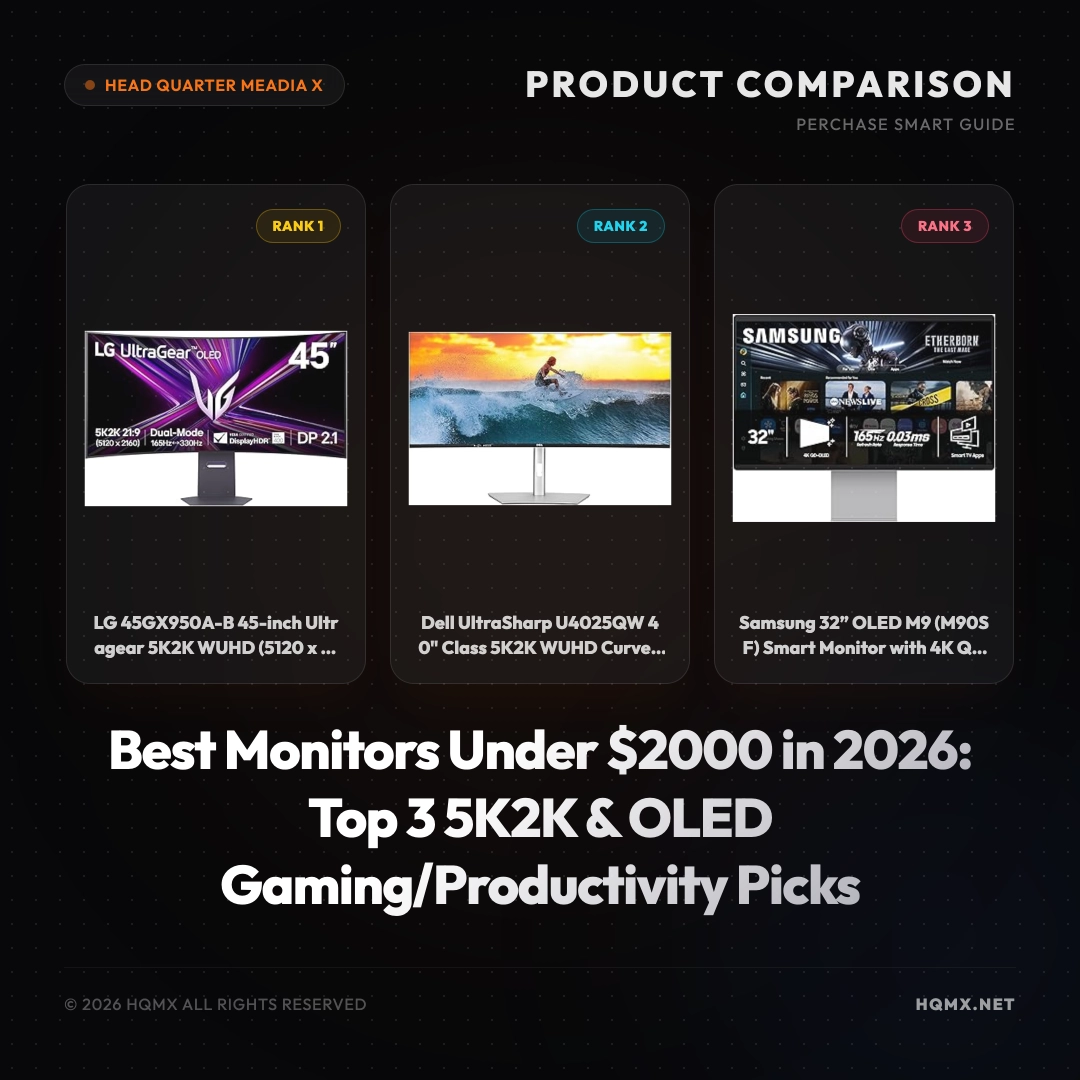
| Key Specifications | LG 45GX950A-B | Dell UltraSharp U4025QW | Samsung M9 (M90SF) |
|--------------|---------------|-------------------------|--------------------|
| MSRP | $1924.92 | $1919.00 | $1599.99 |
| User Score | 4.5 | 4.5 | 4.5 |
| Screen Size | 45 inches | 40 inches | 32 inches |
| Resolution | 5K2K (5120x2160) | 5K2K (5120x2160) | 4K (3840x2160) |
| Panel Type | OLED | IPS Black | QD-OLED |
| Refresh Rate | 165Hz (Dual-Mode) | 120Hz | 165Hz |
| Response Time | 0.03ms | 5ms | 0.03ms |
| Connectivity | DP2.1, HDMI 2.1, USB-C 90W | HDMI 2.1, DP 1.4, USB-C 140W | HDMI 2.1, USB-C 65W |
| HDR | HDR True Black 400 | DisplayHDR 600 | HDR10+ |
| Special Features | G-Sync, FreeSync Premium Pro | Built-in KVM, RJ45 | Smart TV, Gaming Hub |
Analysis 1: LG 45GX950A-B 45-inch Ultragear 5K2K OLED Curved Gaming Monitor
Technical Key Specificationss
The LG 45GX950A-B is a 45-inch ultrawide curved gaming monitor featuring a 5K2K (5120x2160) WUHD OLED panel with a 21:9 aspect ratio. It boasts a blazing-fast 165Hz refresh rate (with dual-mode support for 240Hz at lower resolutions) and an incredible 0.03ms Gray-to-Gray response time, ensuring zero motion blur. The monitor supports both NVIDIA G-Sync and AMD FreeSync Premium Pro for tear-free gameplay. HDR True Black 400 certification delivers deep blacks and vibrant colors, typical of OLED technology. Connectivity includes DisplayPort 2.1, HDMI 2.1, and a USB-C port with 90W Power Delivery. The stand offers height, tilt, and swivel adjustments. Dimensions are approximately 40.1 x 23.5 x 12.2 inches and weight is 28.7 lbs.
Why This Analysis
This monitor is the ultimate choice for gamers and power users who demand the highest refresh rates and fastest response times in an ultrawide format. The dual-mode feature allows switching between high resolution and high refresh rate, making it versatile for both productivity and competitive gaming. Its OLED panel provides perfect blacks and infinite contrast, ideal for HDR content.
Strengths and Limitations
- Strengths: Exceptional 0.03ms response time; 165Hz native refresh rate with dual-mode; OLED infinite contrast and HDR True Black 400; DP2.1 and HDMI 2.1 support; G-Sync and FreeSync compatibility.
- Limitations: Very expensive; large footprint requires ample desk space; OLED burn-in risk with static elements; no built-in speakers.
Analysis 2: Dell UltraSharp U4025QW 40-inch 5K2K Curved Monitor
Technical Key Specificationss
The Dell UltraSharp U4025QW is a 40-inch curved monitor with a 5K2K (5120x2160) resolution and IPS Black panel technology, offering a 2000:1 contrast ratio for deeper blacks compared to standard IPS. It features a 120Hz refresh rate and 5ms response time, suitable for productivity and light gaming. Color accuracy is factory-calibrated to Delta E < 2, covering 100% sRGB, 98% DCI-P3, and DisplayHDR 600 certification. Connectivity includes HDMI 2.1, DisplayPort 1.4, USB-C with 140W Power Delivery, and a built-in KVM switch with RJ45 for seamless multi-device workflow. The stand is fully ergonomic with height, tilt, swivel, and pivot adjustments. Dimensions are 37.2 x 23.8 x 9.7 inches and weight is 24.9 lbs.
Why This Analysis
For professionals in design, video editing, or finance who need expansive screen real estate and color accuracy, this monitor excels. The IPS Black panel provides better contrast than typical IPS, and the 140W USB-C charging is ideal for high-power laptops. The built-in KVM and RJ45 simplify workstation setup.
Strengths and Limitations
- Strengths: Excellent color accuracy (Delta E < 2); IPS Black panel with 2000:1 contrast; 140W USB-C power delivery; built-in KVM and Ethernet; 120Hz refresh rate for smooth scrolling.
- Limitations: 120Hz is lower than gaming-focused rivals; 5ms response time not for esports; no OLED-level blacks; MSRPy for non-gamers.
Analysis 3: Samsung 32-inch OLED M9 (M90SF) Smart Monitor
Technical Key Specificationss
The Samsung M9 is a 32-inch 4K (3840x2160) QD-OLED smart monitor with a 165Hz refresh rate and 0.03ms response time, combining gaming performance with smart TV functionality. It features Samsung Vision AI for picture optimization, built-in Gaming Hub for cloud streaming, and HDR10+ support. The QD-OLED panel delivers vibrant colors and deep blacks. Connectivity includes HDMI 2.1, USB-C with 65W Power Delivery, and a remote control. It runs Tizen OS, providing access to streaming apps. The stand offers tilt and swivel, but height adjustment is limited. Dimensions are 28.3 x 20.1 x 9.8 inches and weight is 16.8 lbs.
Why This Analysis
This monitor is perfect for users who want a versatile display for both gaming and entertainment without needing a separate TV. The 165Hz QD-OLED panel offers excellent gaming performance, while the smart features allow streaming and app usage. It is also the most affordable option in this comparison.
Strengths and Limitations
- Strengths: QD-OLED panel with vibrant colors and deep blacks; 165Hz and 0.03ms response; built-in smart TV with Gaming Hub; 4K resolution; 3-year warranty.
- Limitations: Only 32 inches; no 5K2K resolution; USB-C limited to 65W; stand lacks height adjustment; smart features may feel redundant with external streaming devices.