- Published on
Best Gaming and Productivity Monitors Under $3000 in 2026: Top 3 Comparison
- Authors
- Name
Buyer's Guide: Choosing a Monitor
Before comparing specific models, understand the core technical factors that determine display quality for your use case. These principles apply regardless of brand or MSRP point.
Panel Technology Fundamentals IPS (In-Plane Switching) offers the best color consistency and viewing angles but suffers from IPS glow and lower native contrast (~1000:1). VA (Vertical Alignment) provides 3-5x higher contrast (3000:1-5000:1) with deeper blacks but has narrower viewing angles and slower response times (smearing). OLED delivers per-pixel illumination for infinite contrast and near-instant response but carries burn-in risk and ABL (Automatic Brightness Limiter) constraints.
Refresh Rate vs Response Time Refresh rate (Hz) determines how many frames per second the display can show — 60Hz = 16.7ms frame time, 144Hz = 6.9ms, 240Hz = 4.2ms. Response time (GtG/MPRT) measures pixel transition speed. For competitive gaming, prioritize high refresh rate (144Hz+) with low GtG (<5ms) and minimal overshoot. For productivity, 60-75Hz with good color accuracy often suffices.
Resolution & Pixel Density (PPI) 1080p at 24" = 92 PPI, 1440p at 27" = 109 PPI, 4K at 27" = 163 PPI, 5K at 27" = 218 PPI. Higher PPI means sharper text and UI elements but requires OS scaling. For text-heavy work, ≥110 PPI is recommended. For pure gaming, lower PPI with higher refresh rate may be preferable.
Color Accuracy & Gamut Coverage sRGB (standard web), AdobeRGB (print), DCI-P3 (video/HDR). Factory calibration (ΔE < 2) matters for color-critical work. Wide gamut without proper color management can cause oversaturation in non-color-managed apps.
HDR Implementation True HDR requires ≥1000 nits peak brightness with local dimming (FALD) or OLED. DisplayHDR 400/600 are entry-level; HDR 1000+ delivers meaningful HDR. Many "HDR" monitors only accept HDR signals without proper display capability.
Ergonomics & Connectivity Height/tilt/swivel/pivot adjustment, VESA mount, USB-C with Power Delivery (≥90W for laptops), KVM switching, and adequate port selection (HDMI 2.1, DP 1.4+).
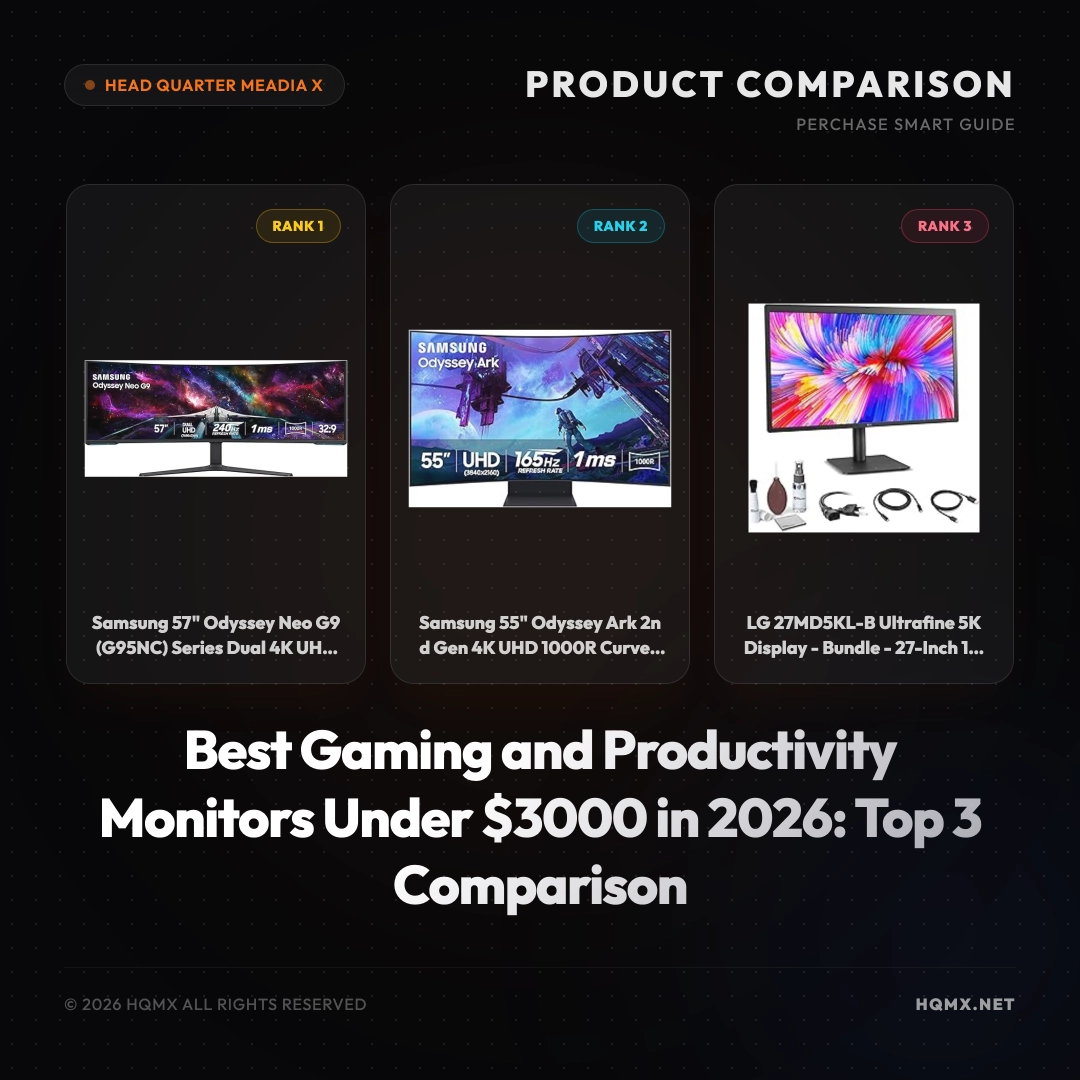
| Feature | Samsung Odyssey Neo G9 57" | Samsung Odyssey Ark 2nd Gen 55" | LG Ultrafine 27MD5KL-B 5K |
|---------|-----------------------------|----------------------------------|---------------------------|
| MSRP | $2099.99 | $2299.99 | $2966.48 |
| User Score | 4.5 | 4.5 | 4.5 |
| Screen Size | 57" | 55" | 27" |
| Resolution | Dual 4K UHD (7680x2160) | 4K UHD (3840x2160) | 5K (5120x2880) |
| Panel Type | VA (Quantum Mini-LED) | VA (Quantum Mini-LED) | IPS |
| Refresh Rate | 240Hz | 165Hz | 60Hz |
| Response Time | 1ms | 1ms | 5ms |
| Curvature | 1000R | 1000R | Flat |
| HDR | DisplayHDR 1000 | HDR 10+ | 500 cd/m² |
| Adaptive Sync | AMD FreeSync Premium Pro | AMD FreeSync Premium Pro | N/A |
| Connectivity | DisplayPort 2.1, HDMI 2.1 | HDMI 2.1, USB-C | Thunderbolt 3, USB-C |
| Special Features | 32:9 aspect ratio, 240Hz | 4-input Multi View, Cockpit mode | macOS compatibility, P3 wide color |
Analysis 1: Samsung 57" Odyssey Neo G9 (G95NC) Series Dual 4K UHD 1000R Curved Gaming Monitor
Technical Key Specificationss
The Samsung Odyssey Neo G9 57-inch monitor is a behemoth designed for immersive gaming and multitasking. It features a 32:9 super ultra-wide aspect ratio with a Dual 4K UHD resolution (7680x2160), effectively combining two 4K screens side by side. The 1000R curvature matches the human field of view, enhancing immersion. Powered by Quantum Mini-LED technology, it delivers exceptional brightness and contrast with DisplayHDR 1000 certification, ensuring vibrant colors and deep blacks. The monitor boasts a blistering 240Hz refresh rate and a 1ms response time (GtG), making it ideal for fast-paced competitive gaming. It supports DisplayPort 2.1, which provides enough bandwidth for full 240Hz at Dual 4K, and includes HDMI 2.1 inputs. AMD FreeSync Premium Pro ensures tear-free gameplay. The monitor has a height-adjustable stand and VESA mount compatibility. Dimensions: 52.7 x 20.4 x 22.2 inches (with stand); weight: 41.9 lbs.
Why This Analysis
We rank the Odyssey Neo G9 first because it offers the most immersive and high-performance experience for gamers and power users who want the ultimate ultra-wide setup. Its Dual 4K resolution combined with 240Hz refresh rate is unmatched in this MSRP range, and the DisplayPort 2.1 support future-proofs the monitor for next-generation GPUs. The Quantum Mini-LED backlight provides excellent HDR performance, making it suitable for both gaming and content consumption. For those who can accommodate its massive size, this monitor is a game-changer.
Strengths and Limitations
- Strengths: Unparalleled 32:9 immersion; Dual 4K resolution with 240Hz; Excellent HDR with DisplayHDR 1000; DisplayPort 2.1 for high bandwidth; Fast 1ms response time.
- Limitations: Extremely large footprint requires ample desk space; MSRP is high but justified; Some users may find the curve too aggressive for productivity; Limited macOS support for full resolution at 240Hz.
Analysis 2: Samsung 55" Odyssey Ark 2nd Gen 4K UHD 1000R Curved Gaming Monitor
Technical Key Specificationss
The Samsung Odyssey Ark 2nd Gen is a 55-inch 4K UHD (3840x2160) curved monitor with a 1000R radius, designed for both gaming and entertainment. It features a 165Hz refresh rate and 1ms response time, delivering smooth and responsive gameplay. The Quantum Mini-LED panel provides high brightness and contrast, supporting HDR 10+ for enhanced dynamic range. A standout feature is the 4-input Multi View, allowing you to connect up to four sources simultaneously and display them on the screen in various layouts. The monitor also offers a unique Cocktail mode that enables the screen to be tilted into a landscape or portrait orientation for different use cases. It includes HDMI 2.1 inputs and USB-C connectivity. The stand is height-adjustable, and the monitor supports VESA mounting. Dimensions: 48.3 x 15.2 x 27.5 inches (with stand); weight: 53.8 lbs.
Why This Analysis
The Odyssey Ark earns the second spot due to its versatility and innovative features. The 55-inch size and 4K resolution make it suitable for immersive gaming and media consumption, while the 4-input Multi View is a boon for multitaskers who need to monitor multiple devices simultaneously. The 165Hz refresh rate and 1ms response time ensure a fluid gaming experience, and the HDR 10+ support enhances visual quality. It is an excellent choice for users who want a large, feature-rich monitor that can adapt to various scenarios, from gaming to productivity.
Strengths and Limitations
- Strengths: Large 55-inch screen with 4K resolution; Innovative Multi View with up to 4 inputs; Cockpit mode for flexible orientation; 165Hz and 1ms for gaming; HDR 10+ support.
- Limitations: Lower resolution than the Neo G9 (only 4K); 165Hz may be less appealing to competitive gamers; Very heavy and requires strong desk; MSRP is high but includes unique features.
Analysis 3: LG 27MD5KL-B Ultrafine 5K Display - Bundle - 27-Inch 16:9 5K (5120 x 2880) IPS Monitor
Technical Key Specificationss
The LG Ultrafine 27MD5KL-B is a 27-inch 5K (5120x2880) IPS monitor specifically designed for macOS users. It offers a pixel density of 218 PPI, providing incredibly sharp text and images. The IPS panel ensures wide viewing angles and accurate colors, covering the P3 wide color gamut. It has a brightness of 500 cd/m² and supports 10-bit color depth. Connectivity is via Thunderbolt 3 (85W power delivery) and USB-C, making it a seamless plug-and-play solution for MacBooks and Mac desktops. The monitor includes a built-in camera, microphone, and speakers, enhancing its all-in-one functionality. It has a sleek, minimalist design with an adjustable stand (height, tilt, swivel). Dimensions: 24.9 x 9.0 x 17.4 inches (with stand); weight: 18.5 lbs. The bundle includes a screen cleaning set.
Why This Analysis
The LG Ultrafine 5K is our top recommendation for creative professionals and Mac users who prioritize color accuracy and high resolution over gaming performance. Its 5K resolution provides ample screen real estate for detailed work, and the Thunderbolt 3 connectivity simplifies setup with a single cable. The P3 wide color gamut and 500 cd/m² brightness make it ideal for photo and video editing. While its 60Hz refresh rate and 5ms response time are not suited for competitive gaming, it excels in productivity and content creation. For those deeply embedded in the Apple ecosystem, this monitor is a natural fit.
Strengths and Limitations
- Strengths: Stunning 5K resolution with sharp text; Excellent color accuracy (P3 wide gamut); Thunderbolt 3 with 85W charging; Built-in camera, mic, and speakers; Sleek design and macOS integration.
- Limitations: 60Hz refresh rate limits gaming; 5ms response time; High MSRP for a 27-inch monitor; Not ideal for Windows users due to scaling issues; Limited connectivity (no HDMI).
Conclusion
Choosing the right monitor in the $2000-$3000 range depends on your primary use case. If you are a hardcore gamer or a power user who craves the ultimate immersive experience, the Samsung Odyssey Neo G9 57-inch is the clear winner with its Dual 4K resolution and 240Hz refresh rate. For those who value versatility and multi-device management, the Samsung Odyssey Ark 2nd Gen offers a large screen and innovative Multi View feature. Meanwhile, creative professionals and Mac users will find the LG Ultrafine 5K to be an excellent tool for color-critical work, despite its higher MSRP and lower refresh rate. Consider your priorities: gaming performance, multitasking flexibility, or color accuracy, and choose accordingly.