- Published on
Best Gaming Monitors Under $750 in 2026: Top 3 OLED and 4K Picks Compared
- Authors
- Name
Buyer's Guide: Choosing a Monitor
Before comparing specific models, understand the core technical factors that determine display quality for your use case. These principles apply regardless of brand or MSRP point.
Panel Technology Fundamentals IPS (In-Plane Switching) offers the best color consistency and viewing angles but suffers from IPS glow and lower native contrast (~1000:1). VA (Vertical Alignment) provides 3-5x higher contrast (3000:1-5000:1) with deeper blacks but has narrower viewing angles and slower response times (smearing). OLED delivers per-pixel illumination for infinite contrast and near-instant response but carries burn-in risk and ABL (Automatic Brightness Limiter) constraints.
Refresh Rate vs Response Time Refresh rate (Hz) determines how many frames per second the display can show — 60Hz = 16.7ms frame time, 144Hz = 6.9ms, 240Hz = 4.2ms. Response time (GtG/MPRT) measures pixel transition speed. For competitive gaming, prioritize high refresh rate (144Hz+) with low GtG (<5ms) and minimal overshoot. For productivity, 60-75Hz with good color accuracy often suffices.
Resolution & Pixel Density (PPI) 1080p at 24" = 92 PPI, 1440p at 27" = 109 PPI, 4K at 27" = 163 PPI, 5K at 27" = 218 PPI. Higher PPI means sharper text and UI elements but requires OS scaling. For text-heavy work, ≥110 PPI is recommended. For pure gaming, lower PPI with higher refresh rate may be preferable.
Color Accuracy & Gamut Coverage sRGB (standard web), AdobeRGB (print), DCI-P3 (video/HDR). Factory calibration (ΔE < 2) matters for color-critical work. Wide gamut without proper color management can cause oversaturation in non-color-managed apps.
HDR Implementation True HDR requires ≥1000 nits peak brightness with local dimming (FALD) or OLED. DisplayHDR 400/600 are entry-level; HDR 1000+ delivers meaningful HDR. Many "HDR" monitors only accept HDR signals without proper display capability.
Ergonomics & Connectivity Height/tilt/swivel/pivot adjustment, VESA mount, USB-C with Power Delivery (≥90W for laptops), KVM switching, and adequate port selection (HDMI 2.1, DP 1.4+).
Specifications Comparison
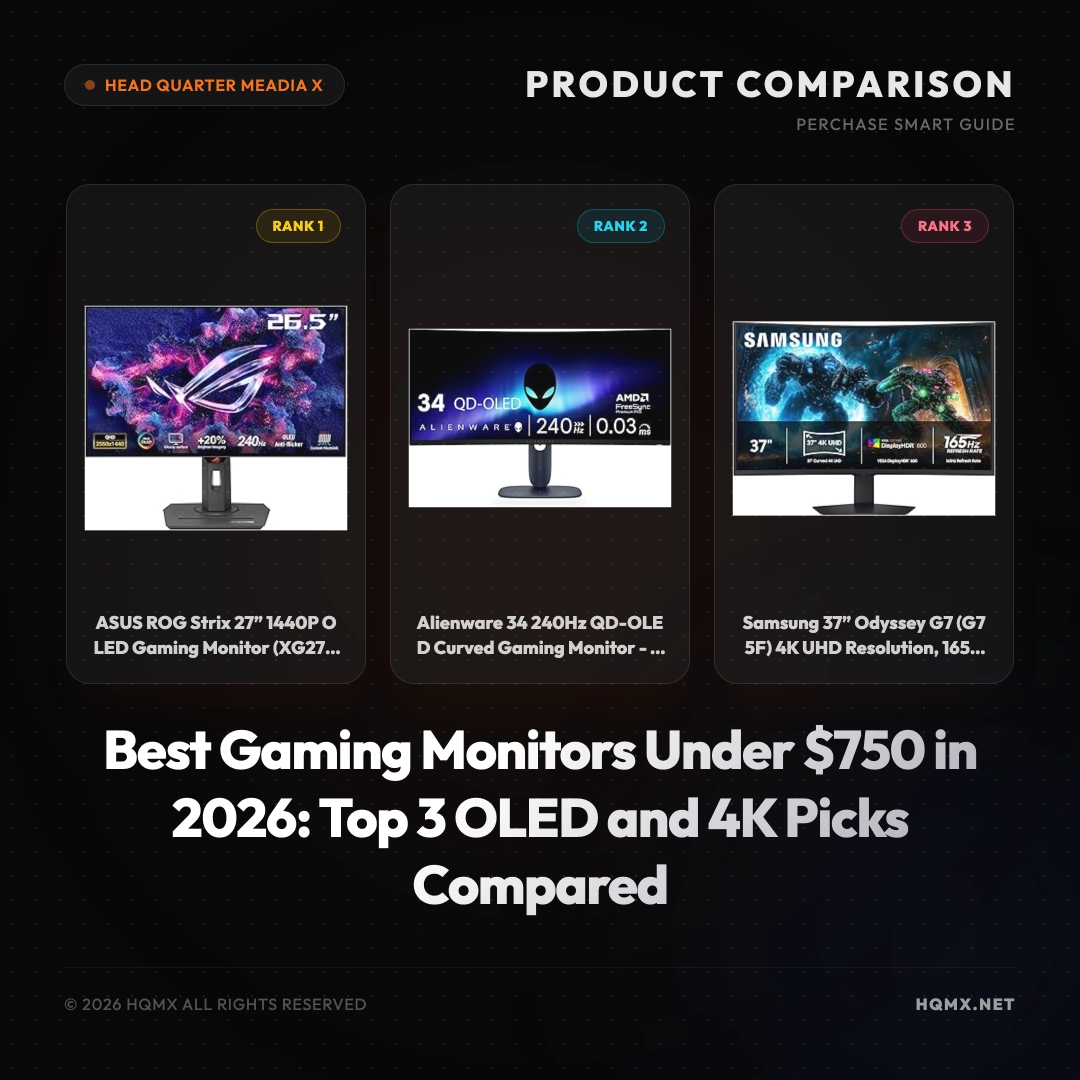
| Feature | ASUS ROG Strix XG27AQDMG | Alienware AW3425DW | Samsung Odyssey G7 G75F |
|---|---|---|---|
| MSRP | $599.00 | $749.99 | $599.99 |
| User Score | 4.5 | 4.5 | 4.5 |
| Screen Size | 27" | 34.2" | 37" |
| Resolution | QHD (2560x1440) | WQHD (3440x1440) | 4K UHD (3840x2160) |
| Panel Type | Glossy OLED | QD-OLED | VA (curved) |
| Refresh Rate | 240Hz | 240Hz | 165Hz |
| Response Time | 0.03ms | 0.03ms | 1ms (GtG) |
| Adaptive Sync | G-SYNC Compatible | AMD FreeSync Premium Pro, VESA AdaptiveSync | AMD FreeSync Premium Pro |
| HDR | VESA DisplayHDR True Black 400 | VESA DisplayHDR True Black 400 | VESA DisplayHDR 600 |
| Curvature | Flat | 1800R | 1000R |
| Warranty | 3 years | 3 years | 1 year (limited) |
Analysis 1: ASUS ROG Strix 27” 1440P OLED Gaming Monitor (XG27AQDMG)
Technical Key Specificationss
The ASUS ROG Strix XG27AQDMG features a 27-inch glossy OLED panel with QHD resolution (2560x1440) and a blazing 240Hz refresh rate. Its 0.03ms response time virtually eliminates motion blur. The monitor includes a custom heatsink for better thermal management, anti-flicker technology, and uniform brightness settings. Color accuracy is outstanding with 99% DCI-P3 coverage. It supports G-SYNC Compatible and is VESA DisplayHDR True Black 400 certified. The monitor comes with DisplayWidget software for easy OSD control and a 3-year warranty. Dimensions: 24.1 x 21.5 x 10.2 inches; weight: 13.2 lbs.
Why This Analysis
This monitor offers the fastest response time and highest refresh rate in the QHD OLED category. The glossy OLED panel delivers vibrant colors and deep blacks, making it ideal for competitive gaming and media consumption. Its custom heatsink ensures stable performance during long sessions. At $599, it provides excellent value for a premium 27-inch OLED.
Strengths and Limitations
- Strengths: Exceptional motion clarity with 0.03ms response; glossy OLED provides vivid colors and true blacks; 240Hz refresh rate for smooth gameplay; G-SYNC Compatible reduces tearing; 3-year warranty adds peace of mind.
- Limitations: Glossy screen may cause reflections in bright rooms; limited to 27-inch size; no HDMI 2.1 for next-gen consoles.
Analysis 2: Alienware 34 240Hz QD-OLED Curved Gaming Monitor - AW3425DW
Technical Key Specificationss
The Alienware AW3425DW is a 34.2-inch ultrawide QD-OLED monitor with WQHD resolution (3440x1440), a 240Hz refresh rate, and 0.03ms response time. Its 1800R curvature enhances immersion. The panel covers 99% DCI-P3 and is VESA DisplayHDR True Black 400 certified. It supports both AMD FreeSync Premium Pro and VESA AdaptiveSync for tear-free gaming. The monitor has a sleek design with Alienware branding and customizable RGB lighting. Dimensions: 31.9 x 21.3 x 12.5 inches; weight: 17.6 lbs.
Why This Analysis
This monitor combines the immersive ultrawide format with QD-OLED technology, offering deep blacks and vibrant colors across a wider field of view. The 240Hz refresh rate and 0.03ms response make it excellent for fast-paced gaming. It is ideal for users who want a cinematic experience without sacrificing competitive performance.
Strengths and Limitations
- Strengths: Immersive 34-inch ultrawide with 1800R curve; QD-OLED panel delivers superior color and contrast; 240Hz and 0.03ms response for elite gaming; supports both FreeSync Premium Pro and VESA AdaptiveSync; excellent build quality.
- Limitations: Higher MSRP at $749.99; ultrawide may not suit all game types; requires a powerful GPU to drive 3440x1440 at high frame rates; glossy coating may reflect ambient light.
Analysis 3: Samsung 37” Odyssey G7 (G75F) 4K UHD 165Hz Curved Gaming Monitor
Technical Key Specificationss
The Samsung Odyssey G7 G75F features a 37-inch 4K UHD (3840x2160) VA panel with a 1000R curvature for maximum immersion. It offers a 165Hz refresh rate and 1ms (GtG) response time. The monitor supports AMD FreeSync Premium Pro and is VESA DisplayHDR 600 certified, providing good brightness and contrast. It has a 3000:1 contrast ratio typical of VA panels. The stand offers tilt, swivel, and height adjustments. Dimensions: 34.2 x 22.8 x 12.1 inches; weight: 18.7 lbs.
Why This Analysis
This monitor provides a large 37-inch 4K display at a competitive MSRP of $599.99. The 1000R curve wraps around your field of view, enhancing immersion in single-player games. With 165Hz and FreeSync Premium Pro, it offers smooth gameplay. It is best suited for users who prioritize screen size and 4K resolution over absolute response time.
Strengths and Limitations
- Strengths: Large 37-inch 4K screen with 1000R curve; 165Hz refresh rate is smooth for most games; VESA DisplayHDR 600 provides good HDR performance; affordable MSRP for its size and resolution; good contrast ratio from VA panel.
- Limitations: 1ms response time is slower than OLED competitors; VA panel may have black smearing in dark scenes; limited to AMD FreeSync (no G-SYNC compatible); only 1-year warranty.
Conclusion
Choosing the right monitor depends on your priorities. For competitive gamers who want the fastest response and smoothest motion, the ASUS ROG Strix XG27AQDMG is the best choice at $599. If you crave an immersive ultrawide experience with top-tier QD-OLED colors, the Alienware AW3425DW at $749.99 is unmatched. For those who want a large 4K screen for immersive single-player games and productivity, the Samsung Odyssey G7 G75F offers great value at $599.99. All three are excellent picks within the $550-$750 range.